The writer and the algorithm: reflections after a debate with writers and editors where I didn’t get to say everything I’d planned
I’m the kind of person who walks into a debate with neatly organized ideas, my homework done, examples lined up – and walks off the stage having said only half of them. Not because I ran out of time or froze with nerves, but because – somewhat unexpectedly – I wasn’t the only one with something worth saying. And so I’m left with that familiar feeling: I started certain ideas… and never quite finished them.
This piece is exactly that – what I managed to say, and more importantly, what I didn’t.
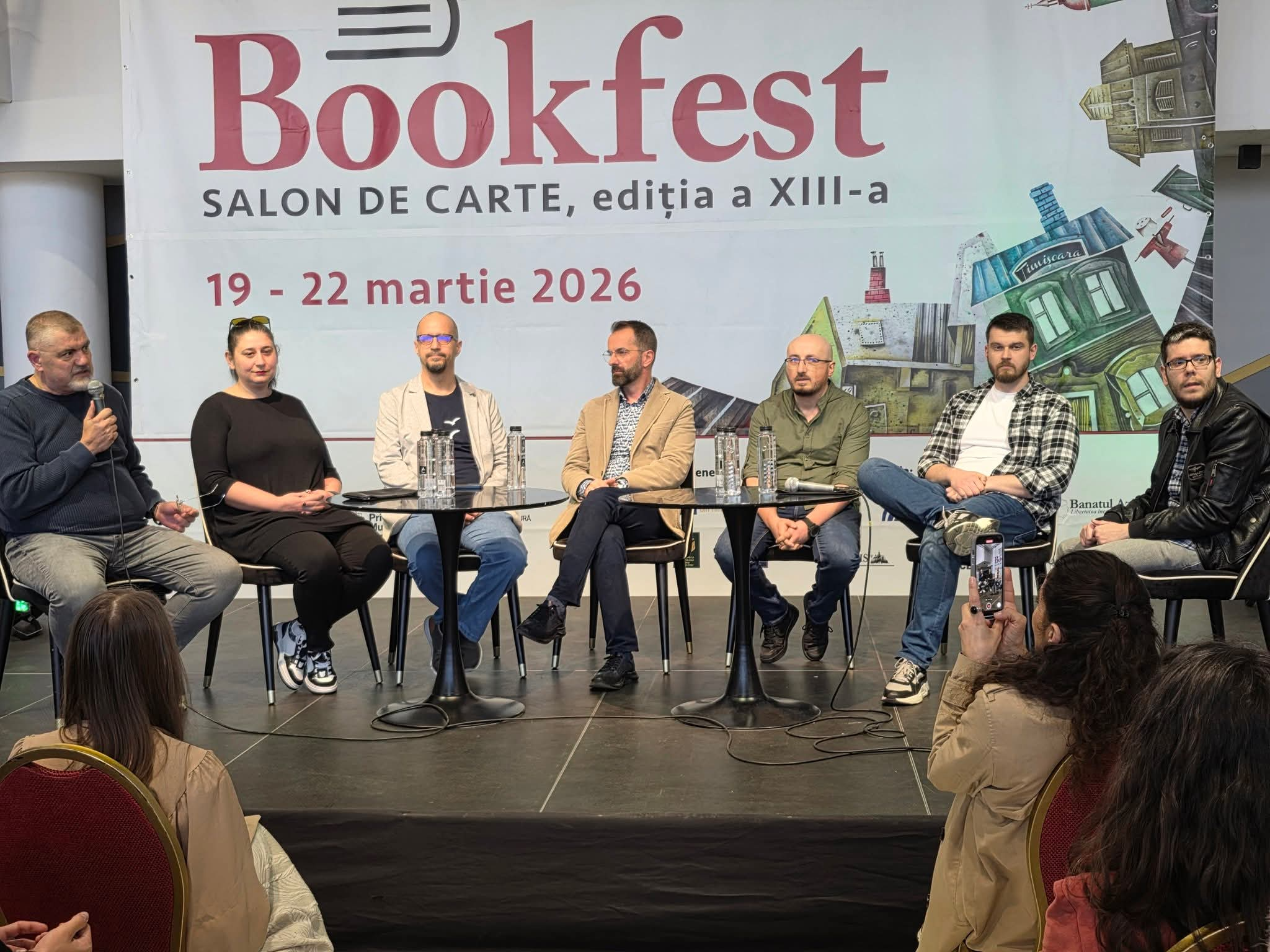
At Bookfest, o book fair in Timisoara, during the panel “The Writer and the Algorithm: Who Will Create the Literature of the Future?” organized by a publishing house, I spoke about something simple that still seems difficult for many to accept: AI is no longer a possibility – it’s a reality. And not just in theory. We already have concrete, well-documented cases that have unsettled the publishing world.
I don’t believe AI should be stopped. I believe it needs to be understood, acknowledged, and used deliberately.
One of the most recent controversies in publishing involves the novel Shy Girl by Mia Ballard, originally released in 2025 and later withdrawn by Hachette Book Group. The book was pulled after readers on platforms like Goodreads and Reddit began noticing patterns typical of AI-generated text. The discussion escalated to the point that the publisher halted distribution altogether, and the book was removed from platforms such as Amazon.
The author denied personally using AI, suggesting instead that a collaborator may have relied on such tools in an earlier draft. But beyond questions of blame, a deeper issue remains: if we can no longer say with certainty who wrote a text, what does authorship even mean?
A particularly relevant case that pushes this question from theory into the legal realm is that of Stephen Thaler and his AI system, DABUS. In 2018, Thaler attempted to register copyright for an image titled “A Recent Entrance to Paradise,” arguing that it had been created entirely by AI. The U.S. Copyright Office rejected the claim, and the case eventually made its way to court. In 2023, a federal court ruled that human authorship is a fundamental requirement for copyright – a decision upheld by the Court of Appeals in 2025. In 2026, the Supreme Court declined to hear the case, leaving that interpretation in place: without meaningful human contribution, there is no author in the legal sense.
This draws a clear – if somewhat uncomfortable – line: AI can be used as a tool in the creative process, but it cannot be considered an author. In practical terms, a work generated entirely by AI belongs to no one and effectively enters the public domain. Where there is human intervention – through selection, editing, or intent – the author remains human. This subtly shifts the conversation: perhaps the question is no longer just “who wrote this?” but “who is willing to stand behind what was written?”
Another example, this time from journalism, pushes the conversation into even more sensitive territory. We’re no longer talking just about authorship, rights, or accountability – we’re talking about truth. A European journalist was suspended after it was discovered that he had used AI to generate quotes, later attributed to real people who had never actually said those words. At this point, the issue is no longer about style, efficiency, or tools that help us write faster. It’s about a direct distortion of reality. Because AI doesn’t just write – it can fabricate reality. And when those fabrications are presented with the appearance of credibility – and aren’t rigorously verified – the line between information and fiction becomes dangerously thin. In this context, the question is no longer just who wrote the text, but whether what we’re reading can still be considered true. This ties directly into a phenomenon that’s being discussed more and more: AI hallucinations.
And yet, the picture isn’t entirely negative. There are also authors who use AI transparently and intentionally.
One often-cited example is the Japanese writer Rie Qudan, who has openly acknowledged using AI in her writing process in order to capture the voice of artificial intelligence more authentically within her narrative. She did so transparently, deliberately, and – perhaps most importantly – with a clear purpose.
And that inevitably leads to a comparison. Because, if we’re honest, the literary world has never been entirely “pure.” There are ghostwriters. There are entire editorial teams working behind well-known authors. It’s often said that writers like Dan Brown rely on extensive teams – sometimes dozens of people – handling research, editing, and narrative structuring.
The difference is that, until now, the “invisible” has been human. Today, the invisible can be algorithmic.
And perhaps that’s one of the defining shifts of our time: we’re no longer just delegating the labor behind a text – we risk delegating the very illusion of authorship. In that sense, AI may become a new kind of ghostwriter – faster, cheaper, and, at times, harder to detect.
I also ran a personal experiment – partly out of curiosity, but also out of a need to understand where we actually stand. I took a text I had written many years ago – back when generative AI wasn’t even accessible to the general public – and ran it through an AI detection system. The result? A 70% probability that it had been written by AI. It even politely asked whether I’d like it to “humanize” the text.
Then I tried the reverse. I took a text generated entirely by AI and ran it through the same kind of detector. The result was almost ironic: only a 19% probability of AI-generated content. A text that was 100% artificial was judged to be, for the most part, human. And that, perhaps, says more than any theory could: we don’t even have truly reliable tools to tell the difference.
Which brings us back, once again, to the same question – if we can no longer clearly distinguish between the two, what does authenticity in writing even mean?
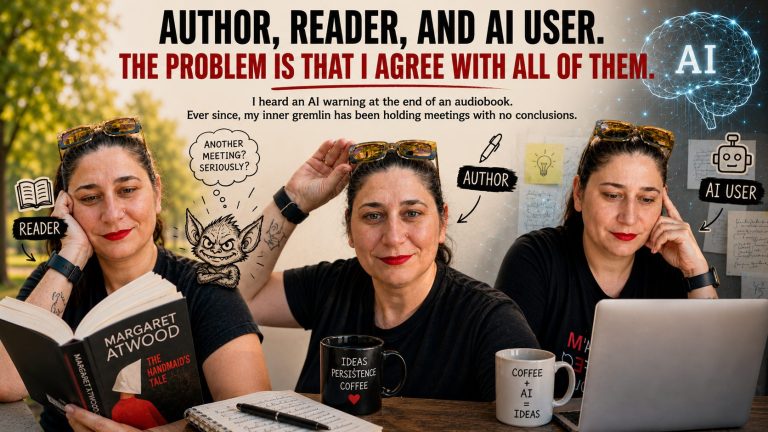
Personally, I don’t see AI as an enemy. I see it as a tool. And I say that from direct experience: I work with AI every day, I write about AI, and I use it constantly – but not for everything. I use it exactly where I struggle: in writing standard texts, press releases, technical documentation – that rigid, correct, but emotionally flat language. There, AI is incredibly effective. It saves time, organizes your thoughts, and gives you structure.
And honestly, it would be very easy to go further – to write more, faster, more efficiently. To optimize everything. But the real question is: what do I give up in return?
When it comes to storytelling, though, things change. Paradoxically, in the middle of this AI boom, storytelling roles are becoming more valuable than ever. Companies like OpenAI, Anthropic, and even Netflix have started offering salaries reaching into the hundreds of thousands of dollars for roles like Head of Storytelling or Brand Narrative Lead. Why? Because in a world where content can be generated instantly, what’s missing is meaning. Not information, not volume – but connection.
And if we look at how AI actually works, this becomes even clearer. At its core, a large language model does something relatively simple: it predicts the most likely next word based on the context before it. And yes, it can produce impressive text. But it has limitations. Over longer stretches, repetition creeps in, patterns emerge, and you start to feel that sense of “I’ve read this somewhere before.” Not necessarily because the writing is bad, but because it doesn’t truly reinvent itself.
A very concrete example came up during the debate, mentioned by Geo Moisi, the organizer of the Bega Noir festival. When a cash prize was introduced for a manuscript competition, several submissions were received that – at least to a trained eye – were clearly AI-generated. And this raises another important question: if the text is good… does it still matter how it was written?
Because, in the end, yes – literature is also a business. Publishers sell. Readers buy. The market decides. If a text is read, appreciated, loved… does it matter whether it was written by a human or an algorithm?
My answer isn’t a radical one. I don’t think AI should be banned. But I do think we need to be honest. If we use AI, we should say so. Not as a confession, not as a source of shame, but as a matter of transparency. We should be clear about whether we used it, how much we used it, and what we used it for. Because the real distinction is no longer between human and AI – but between accountability and the lack of it.
I don’t have a problem with AI as a tool. I have a problem with AI when it becomes an invisible author.
And maybe, instead of fearing it, we should also look at the upside. AI might actually bring real quality to the surface. Because when anyone can write “correctly,” what remains valuable is voice, thinking, perspective.
And perhaps this is where the most uncomfortable question of all emerges: why would you, as a writer, choose to write with AI? What’s really at stake? Publishing faster? Producing more? Or simply seeing your name on a cover? Because, realistically, I doubt anyone is going to build lasting success on mediocre, AI-generated books. The market might be fooled once, maybe twice – but readers don’t stick around where there’s no real value.
So maybe the question isn’t whether AI can write. It can. The question is whether what it writes is worth keeping. Because beyond volume and speed, writing has never just been about producing text – it’s about saying something that matters. And if we reduce writing to a checkbox – “I’ve published a book” – we risk losing exactly what separates an author from a content generator.
AI won’t replace writers. It will expose the ones who never really had anything to say.
I don’t think we know what the world will look like in 50 years. We’re only at the beginning of an era where AI is becoming accessible to everyone, not just those with a technical background. And maybe that’s exactly why we shouldn’t rush to deliver final verdicts.
I don’t think the question is who will create the literature of the future. The answer is simple: everyone. The real question is – what do we still bring to the table?
Because maybe the issue isn’t who writes. The issue is whether truth still matters. We may reach a point where we can no longer tell whether a text was written by a human or by AI. And then it won’t matter how it was written, but who stands behind what we read.
And maybe, on a more personal level: when you read… are you still looking for truth, or just for something that sounds convincing enough to pass as truth?



Facebook Comments