Burnout and mental load in high-performance engineering roles
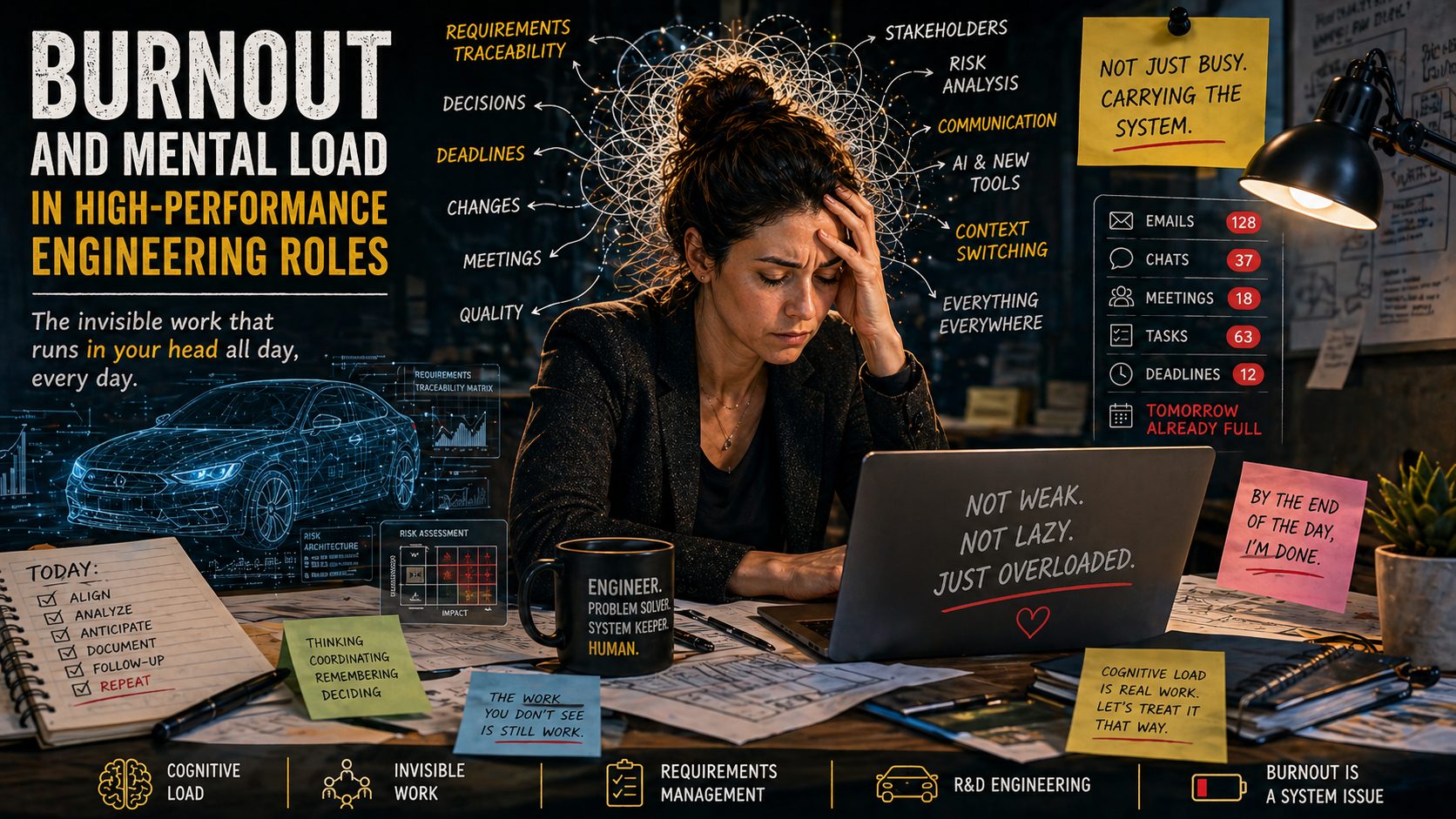
We often talk about being “busy” or “tired” after work, but we rarely talk about mental load — the invisible weight that comes from constantly thinking, remembering, anticipating, coordinating, and deciding. In many modern professional roles, especially in high-performance engineering environments, work doesn’t end when tasks are done or meetings are over. It continues as an ongoing cognitive effort, carried quietly in the background, often unnoticed until exhaustion sets in. This is not about working harder or longer hours. It’s about how much of the system’s complexity lives inside a person’s head — all day, every day, across tools, conversations, decisions, and expectations that rarely align in one place.
I work in the automotive world, in research and development, as a senior engineer and expert requirements manager. And by the end of the day, when the meetings finally stop, when the emails slow down, when everything should be “done”, when in theory it should finally be my time… I’m not there anymore. I don’t have the energy to read, I don’t have the energy to write, I don’t even have the energy to enjoy silence or the things that used to recharge me. All I want is to lie down, scroll mindlessly, or watch something that asks nothing from me — no thinking, no decisions, no remembering, no anticipating. Just silence in my head, because that is the one thing missing all day, even in moments that appear quiet from the outside.
For a long time, I thought something was wrong with me. Maybe I’m not organized enough. Maybe I’m not disciplined enough. Maybe others can handle more, and I just can’t keep up. Maybe if I structured things better, optimized more, tried harder, learned one more framework, used one more tool… it would be different. Until one day, I stopped looking only at what I was doing and started looking at what I was carrying. Not just the visible tasks, not just what can be tracked, measured, reported, or written in a status update, but everything I hold in my head, everything I coordinate, everything I anticipate, everything that doesn’t live in any system but still needs to exist somewhere. And that “somewhere” is, more often than not, my mind — acting as the missing integration layer between tools, people, and decisions.
I started writing things down. At first, just fragments. Then more. Then everything I could catch before it slipped away. And at some point… it hit me. I wasn’t tired because of work itself. I wasn’t tired because of “too many tasks” in the traditional sense. I was tired because of everything running in parallel, all the time, without pause, without closure, without a real sense of completion. Because in reality, my day does not look like a clean, structured to-do list with a beginning and an end. There is no clear “done”. There is no real closure. It looks more like a continuous flow, a wave coming from all directions at once, overlapping, competing for attention, demanding decisions in real time, without giving space to breathe.
And before the day even starts, the previous one is still running.
- Starting the day already carrying yesterday’s unresolved topics.
- Waking up with unfinished conversations still playing in your head.
- Reconstructing context from memory because there was no time to re read notes.
- Realizing the day starts before your calendar says it does.
- Joining the first meeting while mentally preparing for the next one.
And while things are moving fast, you become the memory.
- Tracking multiple parallel threads that do not live in one place.
- Remembering what was decided versus what was only discussed.
- Remembering what was said but never documented.
- Remembering what was implied but not stated.
- Remembering what should have been said and wasn’t.
And on top of that, turning unclear ideas into something solid.
- Translating vague statements into clear, usable outcomes.
- Turning “we’ll figure it out later” into something concrete.
- Detecting missing pieces before anyone realizes they exist.
- Anticipating consequences of small changes that look harmless.
- Checking that pieces created at different times still fit together.
And while doing that, holding everything together.
- Maintaining traceability across tools and versions that don’t fully connect.
- Holding the big picture while working on tiny details.
- Switching topics without losing accuracy or meaning.
- Mentally bookmarking where you left every topic.
And at the same time, shaping how things are understood.
- Adapting language depending on who is listening.
- Saying the same thing in five different ways.
- Defending decisions while staying open to change.
- Preventing misunderstandings before they happen.
- Rewriting the same message so it lands safely.
And before problems exist, already living with them.
- Preparing answers to questions no one has asked yet.
- Mentally simulating problems that may never happen.
- Noticing early warning signs others don’t see yet.
- Adjusting course quietly to prevent future damage.
And without stopping progress, carrying the tension.
- Managing expectations without slowing things down.
- Protecting quality without being labeled as difficult.
- Choosing words carefully so collaboration doesn’t fracture.
- Absorbing frustration so others can keep moving.
And continuously keeping invisible structures aligned.
- Tracking how different pieces depend on each other.
- Ensuring nothing quietly violates critical constraints.
- Making sure nothing drifts outside agreed boundaries.
- Respecting rules that are rarely explicitly stated.
And preparing for moments far in the future.
- Creating documentation no one asked for yet.
- Writing things down because future you will need it.
- Anticipating questions from people who aren’t involved today.
And multiplying the same work across formats.
- Turning one conversation into many outputs.
- Repeating the same content in different shapes.
- Ensuring nothing contradicts itself across channels.
And chasing closure that depends on others.
- Following up on things you don’t own.
- Reminding others without becoming the manager.
- Tracking who said they’d do what.
- Remembering deadlines you didn’t set.
And making hundreds of tiny decisions all day.
- Deciding what needs attention now.
- Deciding what can wait.
- Deciding what requires thinking time.
- Holding tasks in your head so they’re not lost.
And working in permanent interruption mode.
- Being interrupted while doing deep work.
- Remembering where you were before the interruption.
- Restarting your thinking multiple times a day.
And never fully closing the loop.
- Treating meetings as finished externally while they remain open mentally.
- Carrying unresolved threads forward.
- Keeping momentum without a sense of completion.
And when no system connects it all, becoming the system.
- Acting as the glue between tools and people.
- Catching what others forget.
- Keeping continuity across time and conversations.
And on top of everything: staying relevant.
- Keeping up with rapid AI developments.
- Reading about progress, failures, and limitations.
- Filtering signal from noise.
- Thinking about how change will impact your work.
- Learning new tools alongside old responsibilities.
- Making space for learning where no space exists.
- Exploring outside working hours to not fall behind.
- Sharing knowledge learned on personal time.
- Becoming a reference point without capacity allocated.
- Carrying responsibility for the future on top of the present.
And while all of this is happening, meetings never stop.
- Attending meetings that overlap in purpose.
- Joining calls that could have been emails.
- Staying present in meetings that add no clarity.
- Re explaining context that was already shared.
- Leaving meetings with more work than before.
And remaining reachable at all times.
- Being connected via email, chat, phone, and calendar.
- Seeing messages arrive continuously.
- Feeling watched for response time.
- Knowing silence can be interpreted negatively.
- Answering quickly even when thinking is required.
- Interrupting your own focus to stay responsive.
And slowly losing space for yourself.
- Realizing “time for yourself” doesn’t mean rest.
- Understanding it often means unpaid preparation.
- Seeing reflection and learning treated as optional.
- Watching recovery compete with productivity.
- Ending the day with no space left for yourself.
- Feeling guilty for not developing further.
- Feeling guilty for not resting either.
- Postponing both growth and recovery.
- Promising yourself tomorrow will be different.
- Knowing tomorrow is already full.
And after the workday ends, when it should stop.
- Feeling like something was probably forgotten.
- Replaying the day to find what it was.
- Mentally checking lists that don’t exist.
- Thinking about messages you didn’t answer yet.
- Thinking about questions that might come tomorrow.
- Feeling unable to switch off.
- Scrolling just to quiet your brain.
- Being physically present but mentally exhausted.
- Carrying the weight into the evening.
- Falling asleep knowing it will start all over again.
This is only a fraction of it. The real load is bigger — and it never stays organized. It doesn’t wait, it doesn’t line up, it doesn’t respect structure. It runs constantly in the background, reopening threads, switching contexts, pulling attention in multiple directions at once, like a system with no shutdown option. There is no pause button. No clear “off.”
That’s when I understood why the exhaustion isn’t physical, but mental. Why small things slip. Why even one extra task can feel overwhelming — not because it’s big, but because it lands on an already saturated system. Somewhere along the way, I didn’t just become responsible for my work, but for holding the memory of the system — keeping things connected where no tool or role fully does.
When it finally shows, it looks sudden. But it’s not. It’s just the moment when a plate that’s been full for a long time can’t take “one more thing.”
This isn’t a personal failure. It’s systemic cognitive overload — work designed to live inside people’s heads. And until we treat cognitive load as real work, we will keep calling burnout unexpected, while continuing to build the exact conditions that make it inevitable.

Facebook Comments