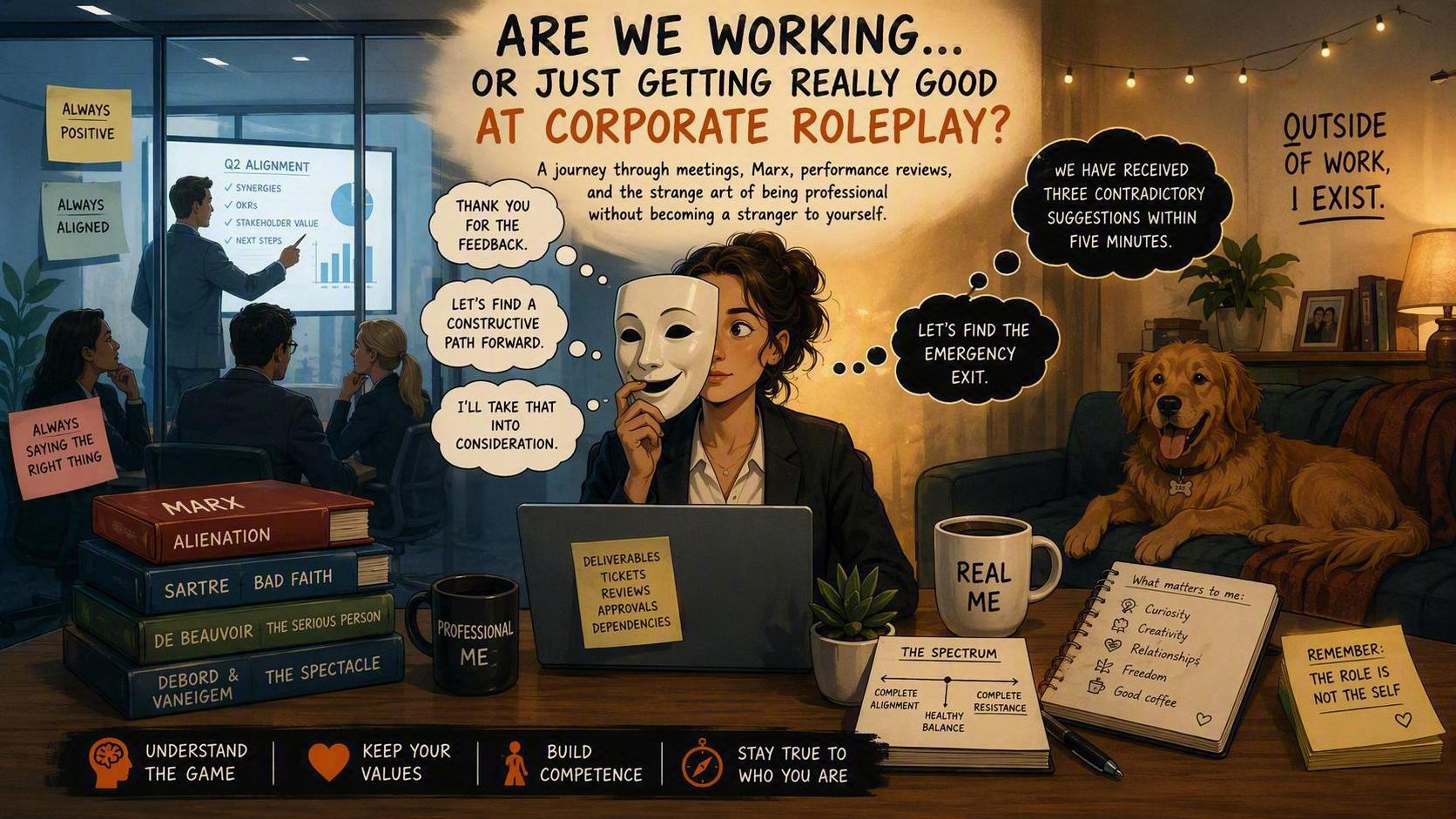
Are we working… Or just getting really good at corporate roleplay? | Professionalism, authenticity, and modern work
A few weeks ago, I caught myself saying: “Let’s align on expectations and revisit this in the next milestone review.” The sentence came out effortlessly, too effortlessly. I paused. Who was speaking? Certainly not the version of me that talks to friends. Not the version that argues with family. Definitely not the version that yells at Excel when a formula stops working for reasons known only to the spreadsheet gods. It was my work personality. The polished, diplomatic, stakeholder-friendly version of me that has somehow learned to survive in the corporate ecosystem. And that got me wondering: At what point does being professional become playing a role? And if we’re all playing roles, are we still being ourselves?
Surprisingly, this question has been debated for almost two centuries. Not in Teams calls, unfortunately, but by philosophers, sociologists, and political thinkers trying to understand what work does to people.
Karl Marx would probably hate our status meetings
When people hear the word alienation, they usually think “I’m tired of my job.” But Marx meant something more specific. Writing in the 1840s, he argued that workers become separated from their work because the things they create don’t really belong to them.
The harder they work, the more value they create for somebody else. In Marx’s view, this creates a strange relationship where people spend their lives building something that ultimately isn’t theirs.
Now, before anyone imagines Marx attending an Agile ceremony and taking furious notes, his ideas were shaped by factories and industrial labor. Software engineering, requirements management, systems architecture, and modern knowledge work are clearly different. Most of us aren’t standing beside giant steam-powered machines. Although some legacy applications come surprisingly close. Wink wink 😀
Still, Marx identified a question that remains relevant: How much of our professional effort serves our own goals, and how much serves goals decided by others? That’s not a revolutionary question. It’s a Tuesday question.
Alienation isn’t one thing. It’s four different things.
One thing I discovered while reading Marx is that alienation is often used as if everyone knows what it means. They don’t. Even Marx seemed to mean several different things at once. If we simplify aggressively (and somewhere a philosophy professor is already reaching for the comment section), alienation can mean:
- Your work benefits someone else far more than it benefits you.
- You’re disconnected from the thing you’re creating.
- Work drains you physically or mentally.
- Your effort serves somebody else’s goals instead of your own.
The first one feels debatable in modern knowledge work. Most of us don’t benefit from our company struggling. If the company succeeds, that usually creates opportunities for everyone involved.
The second and fourth ideas, however, feel surprisingly familiar. How often do we work on a tiny piece of a much bigger picture? Sometimes we’re so focused on deliverables, requirements, tickets, reviews, approvals, and dependencies that the final outcome feels almost abstract.
And let’s be honest: very few of us wake up in the morning thinking “Today I will dedicate my life to updating project documentation version 12.7.” We do it because it contributes to something larger. The challenge is remembering what that larger thing actually is.
The hidden cost nobody talks about
There is another idea from the original debate that fascinated me: not alienation, not role-playing, but humiliation. That sounds dramatic, but bear with me.
Modern organizations require us to absorb small frustrations every day. We accept decisions we disagree with, we support priorities we wouldn’t personally choose, we smile through reorganizations, we politely accept feedback that occasionally feels like it was generated by a random corporate phrase generator. Most of the time, that’s good professionalism. But every compromise leaves a mark. Not a dramatic one, not immediately, just a tiny reminder that organizations are collective systems, not personal kingdoms.
The sociologist C. Wright Mills called professionals “standardized losers” because they repeatedly learn how to lose small battles gracefully. Harsh? Maybe. Accurate? Also maybe.
The problem isn’t working. The problem is forgetting it’s a role.
Fast-forward to the 1960s. Enter Guy Debord and Raoul Vaneigem, members of a fascinating group called the Situationists. Their concern wasn’t factories, it was something else: advertising, television, mass media and the growing feeling that people were becoming actors in their own lives. Their argument was bold: People don’t just work, they perform roles. Employee. Manager. Expert. Leader. Customer. Influencer. Stakeholder.
The danger, they argued, isn’t having roles. The danger comes when the role becomes more real than the person. Imagine spending years carefully crafting the perfect professional identity:
- Always positive.
- Always aligned.
- Always supportive.
- Always saying the right thing.
Eventually, a strange question appears: If I’m always performing, when am I just being me? It’s uncomfortable. But also fascinating, because almost everyone who has worked in a large organization has experienced a tiny version of this.

My inner voice has questions
Work Me: “Thank you for the valuable feedback.”
Inner Voice: “We have received three contradictory suggestions within five minutes.”
Work Me: “Let’s find a constructive path forward.”
Inner Voice: “Let’s find the emergency exit.”
The interesting thing is that both voices are real. The professional version isn’t fake. The private version isn’t fake either. Human beings naturally behave differently in different contexts. We’re different with customers than with close friends, different in presentations than at family dinners, different at work than during vacations.
My dog does exactly the same thing. Around me, she’s a chaotic force powered entirely by snacks. Around visitors, she’s basically a diplomat.
Apparently authenticity is more flexible than we think.
Sartre, performance reviews, and the danger of taking work too seriously
French philosopher Jean-Paul Sartre introduced a concept called bad faith. Bad faith happens when we start lying to ourselves about who we are. His lifelong intellectual partner, Simone de Beauvoir, expanded on this idea by describing what she called the serious person. This is someone who becomes completely absorbed by an external system of values, someone who stops questioning, someone who assumes that the existing rules are absolute truths.
Now let’s modernize that idea. Imagine saying “My performance review determines my value as a person.” Or “My objectives define my purpose.” Or “If my project succeeds, I matter. If it fails, I don’t.”
Most of us would immediately recognize the problem. Projects change, strategies change, leadership changes, organizational charts reproduce faster than rabbits. If your identity is built entirely on organizational structures, sooner or later those structures will move underneath you.
And when they do, you’re left asking “Who am I when the project ends?”
The most powerful idea: the standardized loser
The most compelling observation in the entire discussion may actually come from American sociologist C. Wright Mills. He described modern professionals as becoming what he called a “standardized loser.” It sounds harsh, but think about it. Every professional eventually experiences situations where they must:
- Accept decisions they disagree with.
- Support priorities they didn’t create.
- Remain calm when frustrated.
- Smile through organizational changes.
- Adapt to shifting expectations.
In short, being professional often means losing small battles gracefully. We rarely talk about this. Yet it’s a significant part of corporate life. Not because organizations are evil, but because organizations are collections of competing priorities. And whenever priorities compete, somebody compromises. This is where professional maturity becomes difficult. And where philosophy suddenly becomes surprisingly practical.
The spectrum we all live on
Most professionals end up somewhere between two extremes.
Extreme #1
“My company’s goals are my goals.”
Every objective becomes a mission, every KPI becomes a moral value, every review becomes a judgment of personal worth. Dangerous territory.
Extreme #2
“The organization is the enemy.”
Every process is rejected every manager is questioned, every rule becomes a battle. Also exhausting.
Most successful professionals discover a middle path:
- Support organizational goals.
- Maintain personal values.
- Understand the game.
- Avoid becoming consumed by the game.
That requires awareness. And awareness is harder than compliance.
The surprising antidote
At this point the article could sound a little depressing, I know. Good news is I might have an antidote: competence. The better you become at solving difficult problems, the more freedom you gain. Expertise creates credibility, credibility creates influence, influence creates choices and choices create independence.
This might be why highly skilled engineers, architects, analysts, and technical experts often feel less alienated than people trapped in purely administrative roles. When you’re genuinely good at what you do, you’re not simply following instructions, you’re helping shape outcomes. Power, in this sense, becomes the opposite of alienation. Not power over people, power to influence what happens next.
So… is corporate roleplay dangerous?
My conclusion is: sometimes. Not because professionalism is fake, not because organizations are inherently harmful, not because having a work persona automatically destroys authenticity. The real risk is forgetting that the role is a role. The healthiest professionals I know understand the difference between what they do and who they are. They bring patience, expertise, collaboration, and professionalism to work. But they don’t hand over their entire identity in exchange for a job title and that’s an important distinction, because one day the project will end, the roadmap will change, the organization will restructure, the latest corporate buzzword will be replaced by a newer corporate buzzword, but you’ll still have to recognize the person logging off.
Final thought
I’ve made peace with the fact that Work Me exists. Work Me is calmer than Real Me. Work Me is more diplomatic than Real Me. Work Me can sit through a three-hour meeting and still say, “Thank you, everyone, this was productive.” Real Me occasionally has questions, many questions, mostly about why the meeting could not have been an email. But both versions are me. And maybe that’s the point.
Professionalism isn’t about becoming someone else, it’s about creating a version of yourself that can navigate organizational reality without forgetting where you came from.
The danger isn’t playing the role. The danger is forgetting that it’s a role. Because at some point the project ends, the roadmap changes, the reorganization arrives, the latest strategic buzzword quietly disappears and is replaced by another one that somehow means exactly the same thing. And when all that happens, you’ll still need to recognize the person staring back from the Teams camera. Preferably before you start saying “let’s align on expectations” at family dinner.After all, your work personality might be excellent at stakeholder management… but it shouldn’t be the only version of you that gets a vote. 😉



Facebook Comments