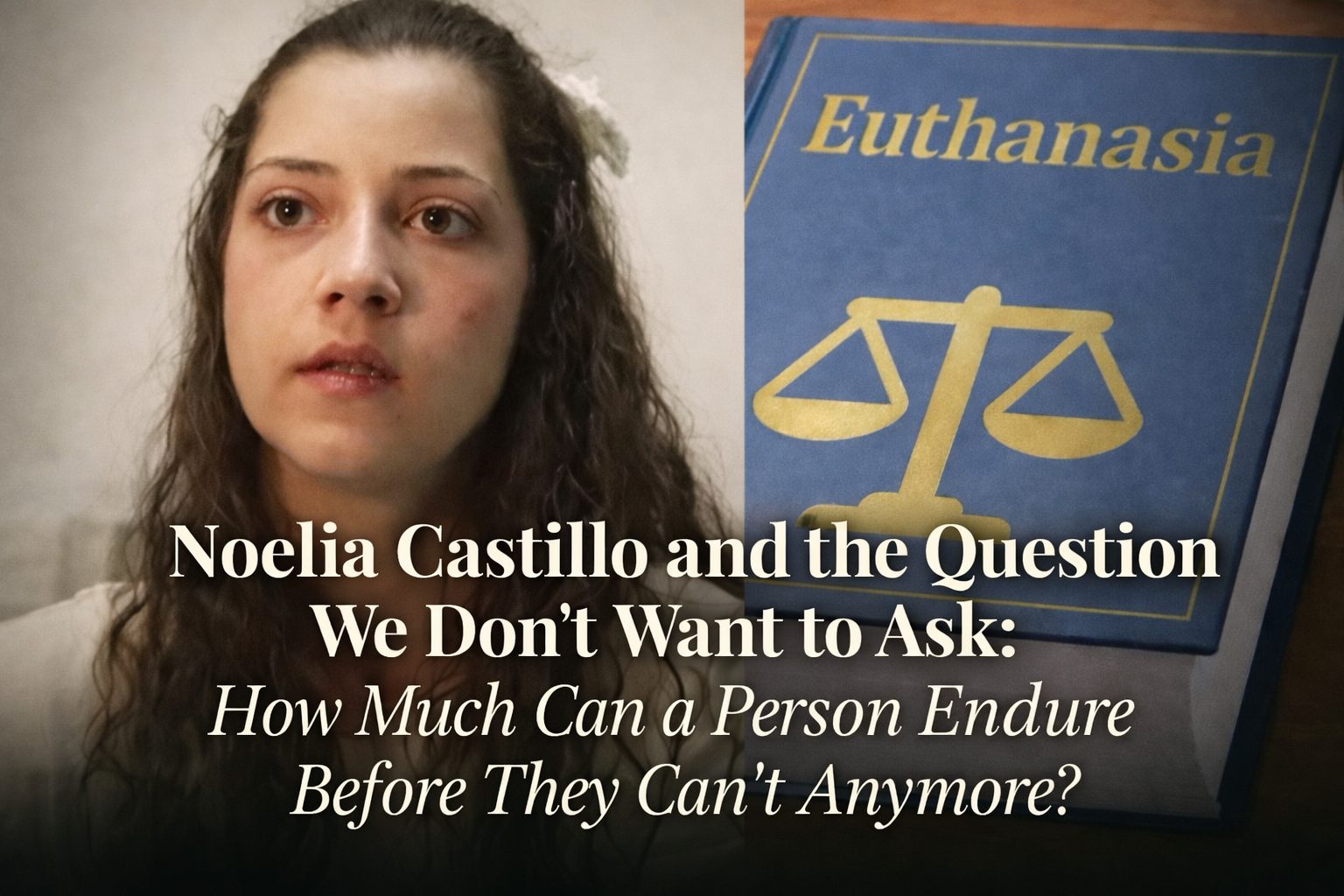
Noelia Castillo and the Question We Don’t Want to Ask: How Much Can a Person Endure Before They Can’t Anymore?
Some stories refuse to be observed from a distance. Not because they’re sensational, but because they hit that exact place where your certainties start to shift.
The case of Noelia Castillo – the young woman in Spain who requested euthanasia – is one of those moments when it’s no longer comfortable to sit behind “I believe that…”. Because beyond opinions, there is a real life here. And not an easy one.
Very quickly, the conversation split into sides: for or against, moral or immoral, acceptable or unthinkable. But beyond all these labels, something far more difficult remains: context.
And before we say anything, we owe it to her – to anyone in a situation like this – to look at the facts. Not to judge, but to understand.
Noelia Castillo’s Story
Noelia grew up in an unstable environment. At 13, after her parents separated, she was placed in a protection center. She wasn’t protected there.
During her teenage years, she was repeatedly sexually abused, including in a group assault. These are documented facts reported in the press – not speculation.
Over time, she was diagnosed with severe depression, obsessive-compulsive disorder, and borderline personality disorder. These aren’t just clinical labels – they describe a psyche already under strain.
At one point, she attempted to take her own life. She survived, but at an enormous cost: a severe spinal injury that left her paraplegic, in chronic pain, and without independence.
From that moment on, her life wasn’t just shaped by her past. It became about a present that was deeply difficult to live through – every single day.
She followed the legal process for euthanasia in Spain, where it is permitted under strict conditions. She underwent both medical and psychological evaluations. Her request was approved.
Her father opposed the decision. He challenged it in court, citing religious beliefs.
The case became public. It moved into the legal arena. It was debated everywhere.
And in an interview, she said simply:
“I need to rest because I can’t anymore; I can’t live with this family, I can’t live with the pain I’m in, I can’t live with all the memories that haunt me.”
Beyond the Facts: What We Don’t See
When we encounter a case like this, our instinct is to focus on what happened: abuse, illness, injury, pain. The visible, tangible facts.
But what matters just as much – if not more – is what internal resources a person has when those things happen.
Trauma isn’t just the event itself. It’s also the absence of a place to return to afterward.
Two people can go through similar experiences and end up in completely different places. Not because one is “stronger,” but because they didn’t start from the same foundation.
Psychology describes this through the concept of secure attachment: early relationships that are stable and predictable, where a child learns there is somewhere safe to return when the world becomes overwhelming.
Without that foundation, trauma doesn’t just hurt – it compounds. It lands on already fragile ground.
If you’ve had even a minimal sense of emotional safety – one relationship that taught you you’re not alone – you have a real chance to process, to rebuild, to carry on.
If you haven’t, each new experience doesn’t just hit you. It finds you already down. And it accumulates.
Until, at some point, there’s nowhere left to put what’s happening to you.
In Noelia’s case, we’re not talking about one thing going wrong. We’re talking about accumulation: family instability, lack of safety, repeated abuse – and on top of all that, psychiatric conditions that affect how emotions and stress are processed.
These aren’t separate pieces. They interact. They amplify each other. And eventually, they shape how a person experiences life – and how much they feel they can endure.
Between the Right to Live and the Right to Decide
This is where the difficult conversation begins: life versus choice.
“Life must be lived, no matter the suffering.” It’s a powerful idea. And in many cases, it holds true.
But it also carries an assumption – that we all have the internal resources to keep going. That no matter what happens, there’s something in us that can sustain us.
That’s not true for everyone.
On the other side is the belief that each person should have the right to decide for themselves. That autonomy matters. Because no one truly lives someone else’s pain.
There comes a point where suffering becomes unbearable – and that point cannot be determined from the outside.
Pain isn’t measurable. It isn’t comparable. And most importantly, it isn’t shared. So the question becomes: who decides? The individual? The family? Society?
In Noelia’s case, that decision ended up in court. Something deeply personal became a matter of public judgment.
And that raises uncomfortable questions: How far can we go in trying to “protect” someone from their own decision? Where does protection end – and where does control begin?
And perhaps even more difficult: are we, as a society, truly prepared to support life in all its forms? Or do we defend it in principle, without confronting what that life actually looks like in reality?
Because supporting life isn’t just about extending it. It’s about creating conditions where life can actually be lived – with dignity, meaning, and real support.
Comparisons and the Limits of Empathy
Another common response is comparison:
“I’ve been through hard things too – and I kept going.”
“I suffered, but I didn’t give up.”
And yes, some people go through unimaginable hardship and continue. But that doesn’t mean everyone can. Because we don’t all start from the same place. Some people have roots. Others have emptiness.
And when trauma, physical pain, and lack of support are added to that emptiness, it’s no longer just about willpower.
At that point, comparisons aren’t just unhelpful – they’re unfair. Because they reduce an entire life to a single question: how much can you endure?
And at the same time, we talk a lot about life as a principle – but far less about what life actually looks like for the person living it. Because life isn’t just the fact that you’re breathing. It’s how you live between breaths.
When There’s Nothing Left: The Human Limit
There’s a point we rarely talk about: when a person truly can’t go on. Not that they don’t want to – they can’t.
No psychological resources left. No emotional energy. A body that no longer supports them. No safety net. No visible way out.
And still, we ask:
“Why don’t they fight?”
“Why don’t they try?”
“Why don’t they hope?”
Because we assume there’s still something left to fight with. But what if there isn’t?
Psychology describes this as total exhaustion – a state where the mechanisms that normally help us cope simply stop working.
At that point, it’s no longer about willpower. It’s about limits. And even the idea of “choice” becomes complicated.
How free is a decision when it’s made under constant pain, accumulated trauma, and the absence of real support?
The Question That Remains
I’m someone who believes in life. I believe in God. I believe life has meaning – even when it hurts. And if I’m honest, part of me still sees taking one’s own life as a form of surrender I struggle to accept.
But reading her story, something shifts. Not in what I believe – but in how I judge. Because this isn’t about me. It’s not about what I would do. It’s about how much a person can carry… before they simply can’t anymore.
I don’t agree. But I can’t fully say I’m against it either. What I can do is recognize that there are lives I cannot fully comprehend – and decisions I cannot make in someone else’s place.
So the question remains: If we don’t live in someone else’s body, mind, and history – how certain can we really be about how much they should endure?



Facebook Comments